
[CoachCorner] When Metabolic Flexibility and Performance Move Together: Matteo’s Case Study
A practical example of how metabolic flexibility can be improved without energy restriction or compromised training.

Over the past year, I’ve discussed periodized nutrition and metabolic flexibility as important aspects of endurance performance, particularly for athletes targeting long events (say, longer than 2-3 hours). The goal is to improve the athlete’s ability to rely on fat during races, preserving glycogen and delaying fatigue, something I have used extensively last year to improve my own performance. If you are new to this, see here for a detailed overview of the topic, or here for a few more advanced pointers.
Despite metabolic flexibility being well supported physiologically and in the scientific literature, the practical implementation of these methods is often misunderstood and reduced to fasted training or chronic carbohydrate restriction, neither of which I would recommend to endurance athletes.
In this blog, I’ll cover the case study of Matteo, an ultratrail runner I’ve been working with, whose goals and training profile made metabolic flexibility a relevant area to attempt to improve, and with whom I have worked towards that goal, using a more nuanced and sustainable approach.
Let’s get to it.
Baseline Testing: Identifying Limiters
One key point before embarking on this journey is that rather than assuming metabolic flexibility is a limitation, we need to test it objectively. Even if we work towards a sustainable approach (details later), we do need to make some changes that are somewhat in conflict with our current habits and cultural context (as these have likely led to our poor metabolic flexibility!), and as such, it wouldn’t make much sense to do so if we weren’t lacking metabolic flexibility (unless we had other reasons to go there, e.g. health related, but I’ll spare you the lecture on glycemic control for today).

Matteo lives nearby, and as such, I could test him at my lab. As I typically do, he underwent laboratory testing, including a VO2max test and a submaximal test to assess substrate utilization, running economy, ventilatory thresholds, and heart-rate responses at various intensities. What we care about here is the submaximal test mostly, as in this test, we use long steps to reach steady state and can assess the metabolic response more accurately than we would be able to do during a shorter maximal test.
The results showed a clear pattern: fat oxidation rates were very low, even at slow speeds, around ~0.3 g/min, with a strong reliance on carbohydrates across all intensities and no crossover point (i.e., at no intensity, he was burning more fat than carbohydrates):

For an ultratrail runner, this profile can be problematic. Heavy reliance on carbohydrates at low and moderate intensities (i.e., poor metabolic flexibility) increases the likelihood of early glycogen depletion, compromising performance. Finally, poor metabolic flexibility complicates fueling strategies during long events, as it limits our options (more considerations on this, here).
Below, I plotted the breakdown of total energy in terms of fat and carbohydrates, and we can also see here that he’s running on carbs only:

The lab data provided a clear rationale to intervene, while also giving us a baseline to evaluate whether any changes would be meaningful.
Matteo had already finished various ultramarathons, but struggled a lot in the past year to finish some of his key races, or to simply feel good during them, often in relation to his nutrition.
Together with my work on HRV, the recent work I’ve done on metabolic flexibility was one of the reasons he approached me, meaning that he was already highly motivated in attempting a different avenue, which was quite different from what he had tried in the past (i.e., maximizing carbohydrate intake).
This is why we decided to give it a go.
Dietary Changes: Shifting Emphasis Without Restricting Energy
As we started the nutritional intervention, we were intentionally conservative, but at the same time, we wanted to give ourselves a good chance to succeed. In practice, this means that there was no caloric restriction, no prolonged fasted training, and no blanket removal of carbohydrates. Instead, we selectively shifted macronutrient emphasis based on session demands.
Easy runs were often preceded by protein- and fat-based meals (eggs, avocados, Greek yogurt, nuts, nut butters), while harder workouts and long runs were appropriately fueled with carbohydrates before and during the run. This approach mirrors my periodized nutrition framework, where fuel availability is matched to the expected demands of the session rather than applied uniformly. This is how we can improve fat metabolism without compromising our top-end capacity, or in other words, how we become metabolically flexible, which is key to endurance performance success.
I have asked Matteo to log everything he ate for about 10 days before we started manipulating his diet, and then again three months later for another 10 days. While these are just approximate breakdowns (we logged meals without weighing anything or counting calories), we can see the (again, approximate) shift in macronutrients from his previous diet to his current diet:

As we reduce carbohydrate intake on certain occasions, it is rather normal that both protein and fats go up a bit to account for the missing calories.
I will add that when testing again, over roughly three months, Matteo gained about one kilogram. This is worth stressing, because improving fat oxidation is often mistakenly associated with weight loss or energy deficit. In practice, metabolic flexibility can improve substantially even with adequate energy intake or slight weight gain, provided carbohydrate intake is reduced selectively, not chronically.
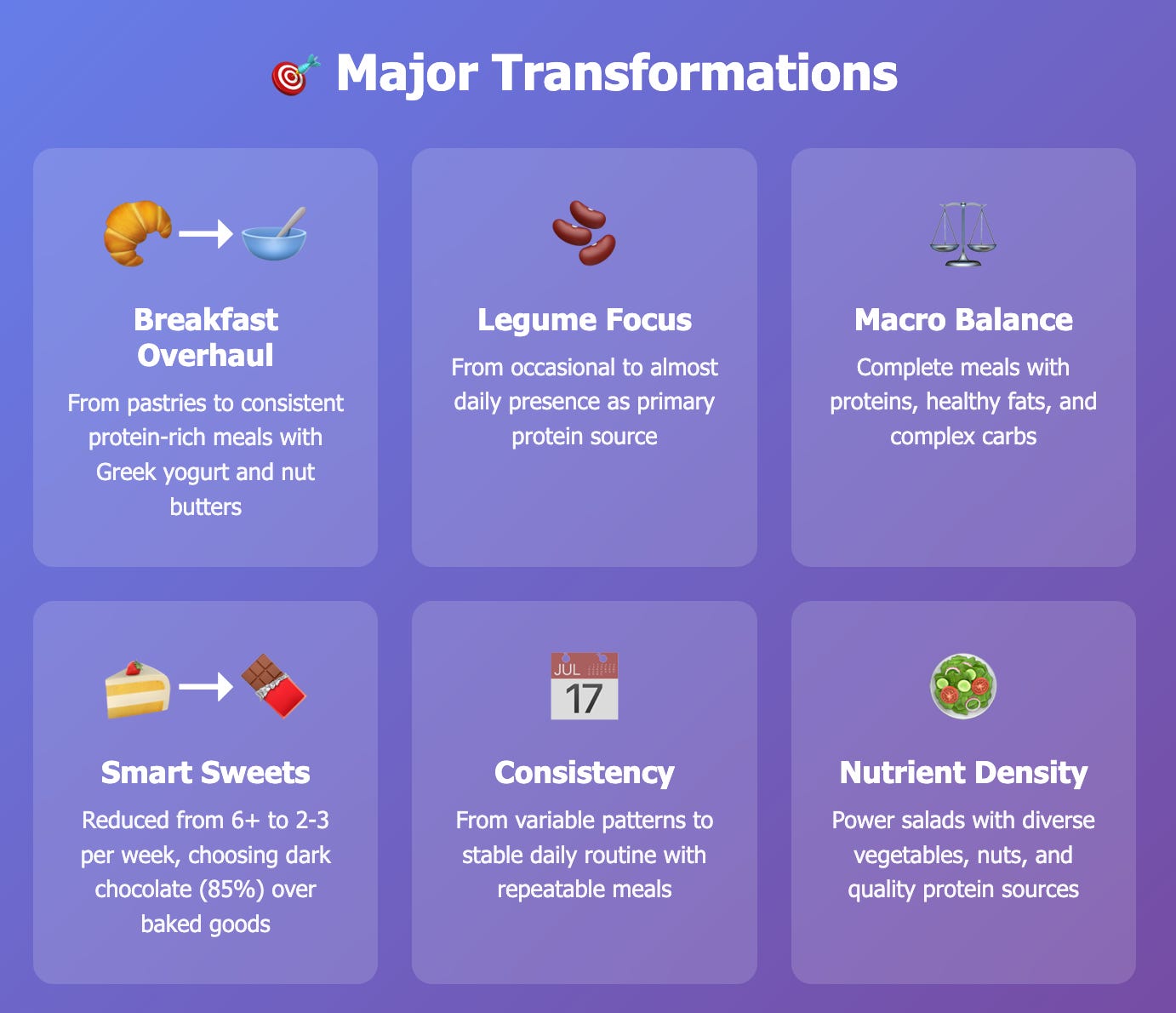
Above, we can see a qualitative shift from a carbohydrate-dominant diet toward higher protein and fat contributions, while carbohydrates remain present. This reflects a change in dietary signaling rather than restriction.
Training progression: Volume, Intensity, and Progress
Importantly, the work on metabolic flexibility did not slow down training progress as we were shifting from a Base training block to a Support training block for Matteo’s spring ultramarathon (Chianti 73k).

Over this same period, training volume increased gradually and structure improved, with the inclusion of more threshold work and longer runs that over time started to get a bit more specific. This shows how metabolic work did not require reducing load or did not impact negatively Matteo’s ability to tolerate load. We can also see that his key sessions have improved in quality, with faster and longer threshold workouts, for example:

Follow-up Testing: Metabolic and Cardiovascular Adaptations
When Matteo returned to the lab after about 10 weeks, the changes were clear. Fat oxidation rates were substantially higher across all submaximal speeds, with meaningful contributions even at moderate intensities (which I consider what matters the most).
Additionally, heart rate was lower at the same speeds, suggesting that improvements in metabolic flexibility occurred alongside improvements in cardiorespiratory fitness:
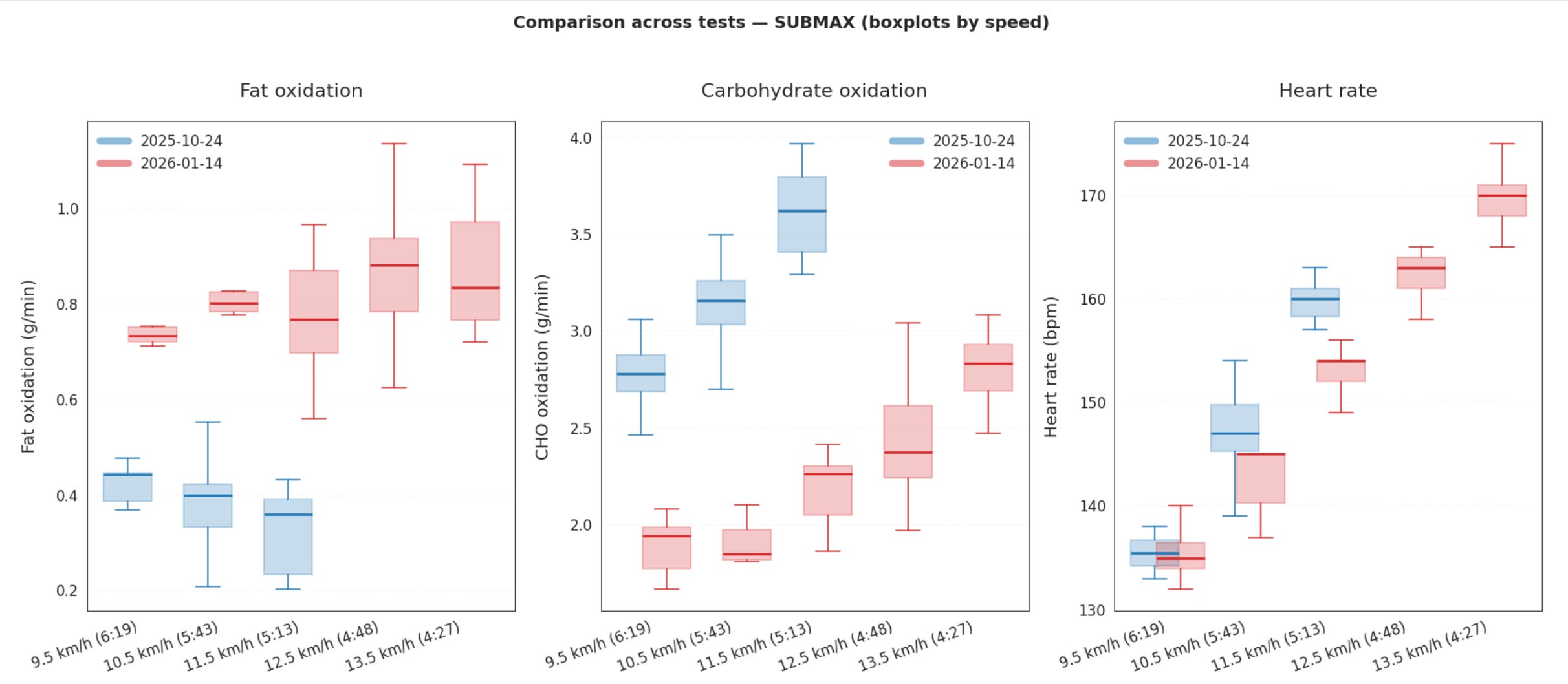
Most importantly, Matteo has been feeling great during training, and was able to run long, multiple times per week, and all while being very flexible on fueling (i.e., feeling very good for several hours of running even with limited carbohydrate intake, which is a valuable skill to have in long races where gastrointestinal issues tend to happen).
Key Takeaways
Matteo’s case shows that metabolic flexibility and performance are not competing goals; quite the contrary. When nutritional changes are selective, sustainable, and aligned with training demands, it is possible to improve substrate utilization while maintaining or improving training quality, workload, and fitness.
Once again, metabolic flexibility is not about fasted training, weight loss, or carbohydrate avoidance. It is about improving the athlete’s ability to match fuel use to intensity, which is particularly relevant for long-duration endurance events. On the flipside, you can have poor fat oxidation rates even when training fasted on a daily basis (maybe for practical reasons), if, for example, your diet (and genetics) do not support metabolic flexibility adequately.
Needless to say, this is a single-athlete case study and should be interpreted accordingly. Individual responses to dietary and training interventions vary based on genetics, training history, and baseline metabolic profile, even though we could fairly say that for most people, and contrary to popular belief, 75% of metabolic flexibility comes down to diet, and 25% to training (as Bob Seebohar would say). Some of the figures presented (e.g., dietary macronutrient distribution and training progression plots) are illustrative summaries derived from logs rather than precise nutrient quantification. In case you’d like to experiment with nutrition, work with a professional, ideally one who has the required knowledge and tools to truly assess your metabolism and any changes over time.
Finally, this case study aligns with broader observations discussed previously on periodized nutrition and endurance performance. It provides a concrete example of how metabolic flexibility can be addressed pragmatically, without compromising training or long-term sustainability and as such, I hope you have found it useful.
Happy training!
FAQ – Common questions on Metabolic Flexibility in Practice
Do I need to train fasted to improve fat oxidation?
No. In this case, improvements in fat oxidation occurred without systematic fasted training. Selectively reducing carbohydrate intake before (and after) easy sessions is sufficient, while harder workouts and long runs are properly fueled. Fasted training is one possible tool, but it is neither required nor universally appropriate, and the rest of our daily diet will have a greater impact typically.
Does working on metabolic flexibility require a caloric deficit?
No. This intervention did not involve intentional energy restriction, and body weight increased slightly over the intervention period. Improving fat oxidation is not about eating less, but about changing substrate availability and signaling in specific contexts.
Were carbohydrates eliminated or minimized?
No. Carbohydrates remained a regular part of the diet, particularly before long runs and high-intensity sessions. The change was in when carbohydrates were emphasized, not in their complete removal. Obviously, on some occasions, we have fewer carbs (yes, you will survive).
Can this approach harm high-intensity performance?
No. When applied appropriately, there is no reason it should. In this case, training quality, volume, and intensity were maintained or improved alongside metabolic changes. The key is to ensure adequate carbohydrate availability for demanding sessions. I love my carbs and would never go keto, but I do enjoy periodizing my nutrition more than my previous diet. It does take a few weeks to get to this level of enjoyment, and just like any other change, the first weeks won’t be easy.
Is this approach suitable for all endurance athletes?
Not necessarily. Individual metabolic profiles, training background, and event demands matter. This approach is particularly relevant for long-duration endurance athletes, but it should always be guided by context and objective data.

How long does it take to see meaningful changes?
In this case, substantial improvements were observed over roughly ten weeks. The timeline will vary depending on baseline metabolic flexibility, training consistency, and dietary habits, but typically, 6-8 weeks should be sufficient.
Is fat oxidation a performance metric to maximize?
No. Improving metabolic flexibility and in particular, fat oxidation at low and moderate intensities is a means to support performance and sustainability, not an outcome to chase in isolation. The goal is to improve fuel use in a way that complements training and racing demands. There’s no prize for the highest fat oxidation rate, just like there’s no prize for the highest carbohydrate intake during a race (and most importantly, the two can go really well together if you have no gastrointestinal distress!).
Personal Coaching for Runners
Please apply here should you be interested in working with me.
You can also learn more about my coaching, here.
Thank you!

How to Show Your Support
No paywalls here. All my content is and will remain free.
As a HRV4Training user, the best way to help is to sign up for HRV4Training Pro.
Thank you for supporting my work.
The Book is Coming Soon
Keep an eye on my Substack for updates.


Marco holds a PhD cum laude in applied machine learning, a M.Sc. cum laude in computer science engineering, and a M.Sc. cum laude in human movement sciences and high-performance coaching. He is a certified ultrarunning coach.
Marco has published more than 50 papers and patents at the intersection between physiology, health, technology, and human performance.
He is co-founder of HRV4Training, endurance coach at Destination Unknown, advisor at Oura, guest lecturer at VU Amsterdam, and editor for IEEE Pervasive Computing Magazine. He loves running.
Social:
Substack
Strava
Instagram

Have been following your work with interest and really appreciate learning how the science can be practically applied. It’s such a sensible approach! Thank you for sharing.
Insightful to see the data you're collecting to support decisions in training and nutrition.