

I started working with Bruna Maia about 18 months ago. She had been coming back from two stress fractures in the previous three years, and had run about 20 km for her longest run in the previous year and a half.
In a previous blog, I covered Bruna’s training for her first trail marathon at Istria by UTMB (here). In that blog, I also mentioned how we deferred her entry in Chicago, as it was too soon to get back into marathon training.
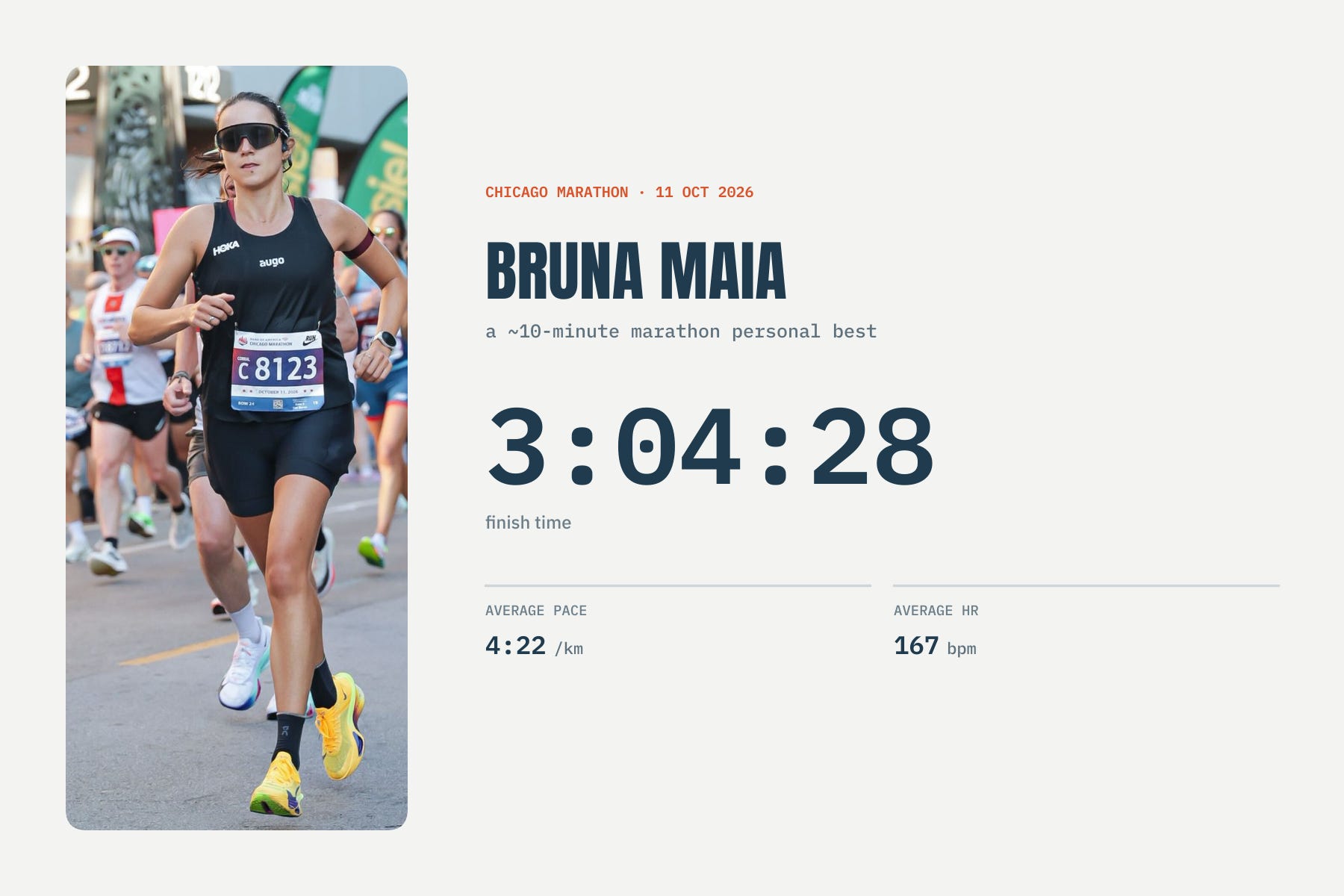
Fast forward one year, and we switched back to road running, aiming to race her best marathon yet, despite a 3-year break from such events (and 4 years since her previous personal best, 3h 14’), due to injuries.
In this post, I will cover:
Moving our whole coach-athlete relationship (communication, planning, analysis) to augo: why and how.
Communication.
Workout and training block planning.
Workout analysis (subjective and objective).
Lab testing and True Individualization: Bruna’s physiology and what it means for her training and fueling beyond “guidelines”.
How We Trained to keep building on spring successes but shifting focus from the trails to the roads.
The first part of this blog, is something for coaches as I’ll cover how we’ve been using augo, the tool Bruna is building, to improve various aspects of coaching.
augo
In an earlier blog, I covered how I use augo in my daily workflow via the MCP connector (see here). Here I want to show you three practical reasons for coaches and athletes to use augo (beyond the obvious facts that Bruna is building the company and I’m helping along the way):
Improved communication with respect to the standard WhatsApp + Comments on whatever coaching platform.
Improved workout and training block planning with respect to the typical workout builder in whatever coaching platform.
Improved workout analysis.
With improved, I mean more effective, more efficient, more useful, with respect to the tools we’ve used until yesterday, as coaches.
Let’s go one by one and look at some examples.
Communication
Currently, if you work with me, we use augo. I do not have any athlete anymore on TrainingPeaks + WhatsApp, my previous setup.
Why? One big aspect is communication. Not only augo provides better ways for me to collect basic feedback on each training session (e.g. a set of predefined questions in which athletes report on how they felt, any physical issues, what they ate, plus the usual open comment field, which can also be a voice message), but also includes a chat just like WhatsApp, which, however, is embedded in the coaching platform and visible to the AI assistant, and as such, can do lots of useful things for me.
For example, Bruna can leave me a voice message either in the chat or as a comment to a workout, and augo automatically transcribes it. Apart from the obvious advantage of being able to read the message, this makes it also searchable by augo’s AI Assistant, which is really the main reason why communication is so much better this way. Think about the typical case in which an athlete mentions something and weeks later you vaguely remember it. Previously I’d had to scroll WhatsApp and to re-listen to a myriad of vocal messages AND open each individual training session in TrainingPeaks, AND hope I’d find what I was looking for in some comment. Now I open augo’s AI assistant, and simply ask “what did Bruna say about her plans for the next race?” and the assistant will bring up all relevant information for me.
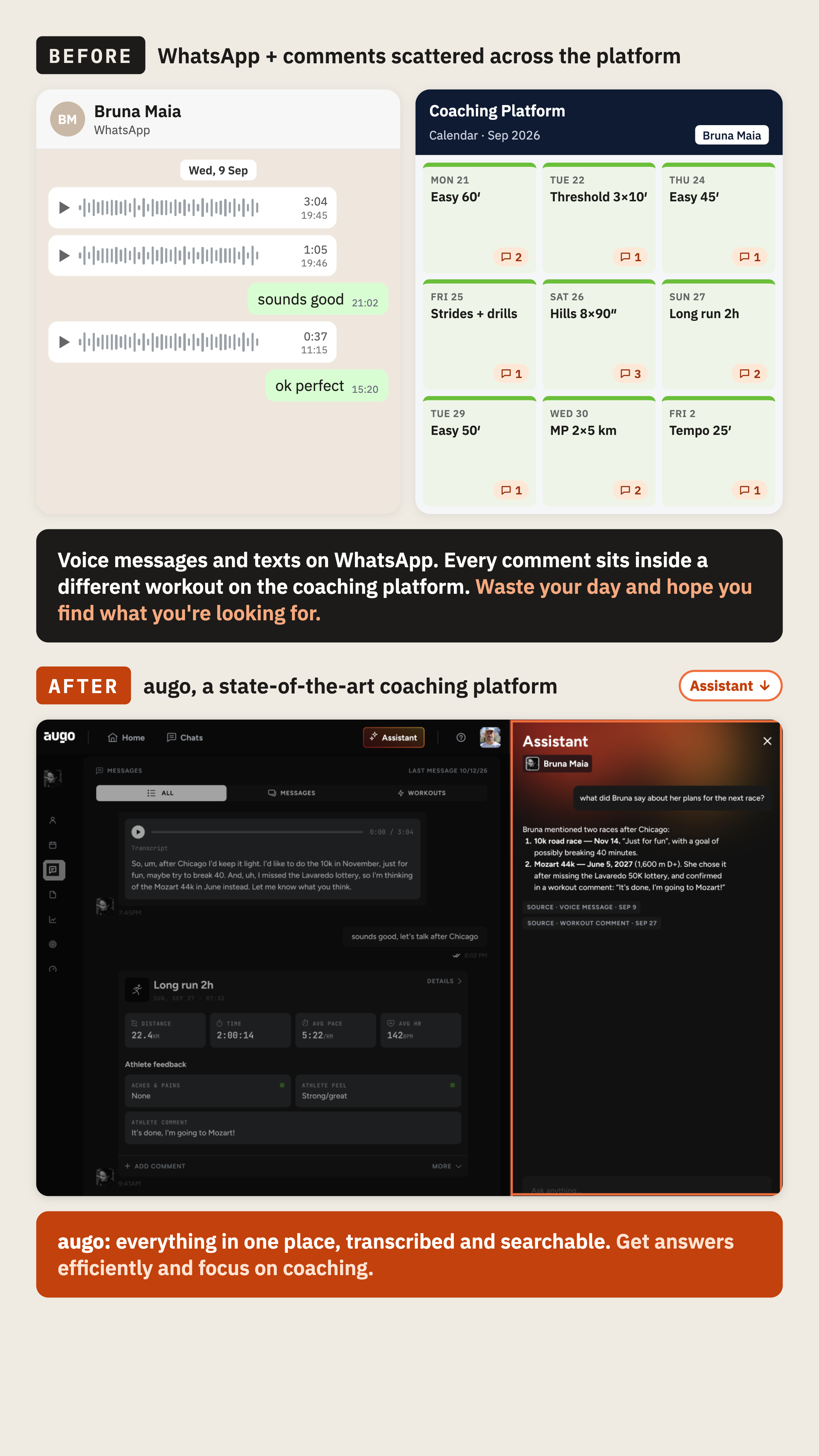
It’s simple things, but they save hours, and this is how coaching should be in 2026.
The previous way (either “banning” athletes from sending voice messages, hence leading to poor communication, or just wasting our time all day) is over.
Workout and Training Block Planning
Another aspect I want to highlight here is how much better it is to create workouts and training blocks or plans using augo.
I used to have a million variants of the same thing on TrainingPeaks, because the alternative is a huge pain in the ass: changing manually everything every time you want to progress a workout or simply to do things a bit differently. You have planned 8 x 90” but the athlete has a track near home and wants to go there; in TrainingPeaks (or any other tool) you’d have to build another workout or edit entirely the current one, often forgetting some minor thing (e.g. I update the actual intervals but forget about the description or even the title), creating inconsistencies for something that, once again, is not really what you should be spending your time doing as a coach. In augo, I have ONE workout per category in my library, because I still want my own words and description of what that type of workout is, but then every time I build something, I just talk to the assistant: hey let’s change the 8 x 90” into a 8 x 400m, or let’s progress it to 10 x 90”, and it’s all done, without ever touching the “workout builder”.
Another case where augo comes in handy is as we get near the race, since I start shifting from prescribing using perceived effort to prescribing to hit a certain pace for the marathon. Before, I’d either need to build new workouts or I would use notes that I put on the calendar and get priority with respect to what the planned workout says, an implicit rule that coaches reading this would get, but also something suboptimal that creates confusion. Once again in augo I can say: hey, for the next long run with intensity, let’s call the intensity marathon-pace and let’s plan to hit a range between 4:15 and 4:20 min/km. Done. Simple things that make your life as a coach so much better.
Finally, creating training blocks. Each athlete is different and has different lives, leading to different weekly structures, of course. For Bruna, some days she’s got tennis, other days she’s cycling, other days she has time to go out for a long run, etc. - this “template” can be even automatically derived by Claude when you link it to augo.
When I build a new block, I ask Claude to draft the next 4 weeks based on Bruna’s typical training availability, and then I focus on adding the key sessions I think we should be doing to get her ready for a good marathon. Once I’m done, Claude can push the entire block to augo, thanks to the MCP Connector I discussed in an earlier blog. As you can see, in augo we use AI for dumb tasks that you can quickly double-check, admin work, so that I can spend more time trying to understand where we are with respect to where we want to be, which training blocks or sessions might get us there, and do what I think coaching is, as opposed to dragging and renaming boxes.
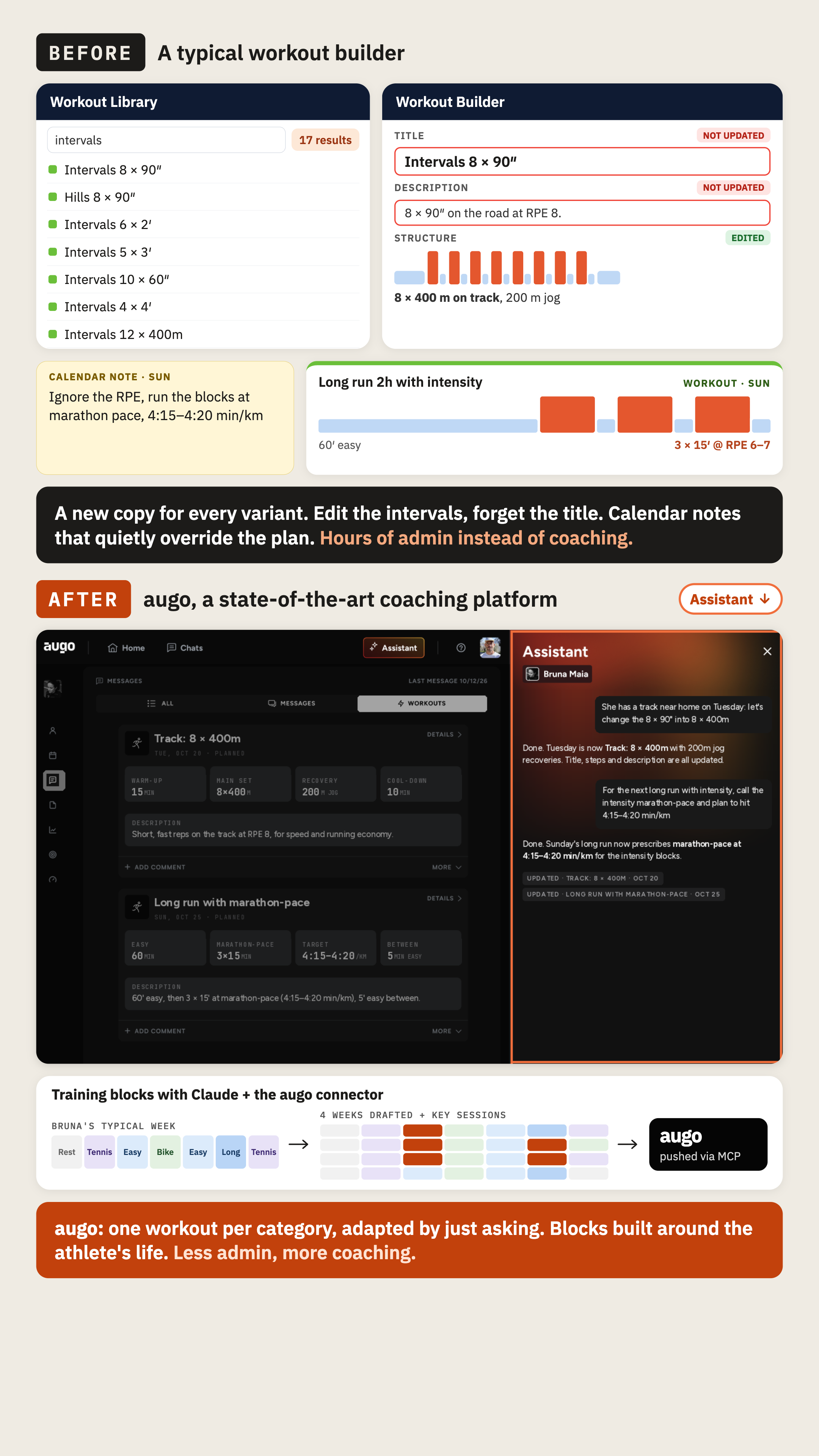
As a result, in augo my library can be minimal, and I can use Claude or the AI assistant in augo to build variations of a session and entire blocks without ever touching the “workout building UI”.
There is no new tool to learn, there is no library to move (even though if you can’t see the future yet, you can also export/import your library), because you can just talk to the assistant and let the system build what you need for a given athlete. It’s a paradigm shift.
Workout Analysis
Workout analysis starts with subjective feedback, which is front and center in augo. After each run, I knew how Bruna felt, if she had any physical issue, how much she ate for breakfast and during the run, etc. (see an example in Bruna’s instagram).
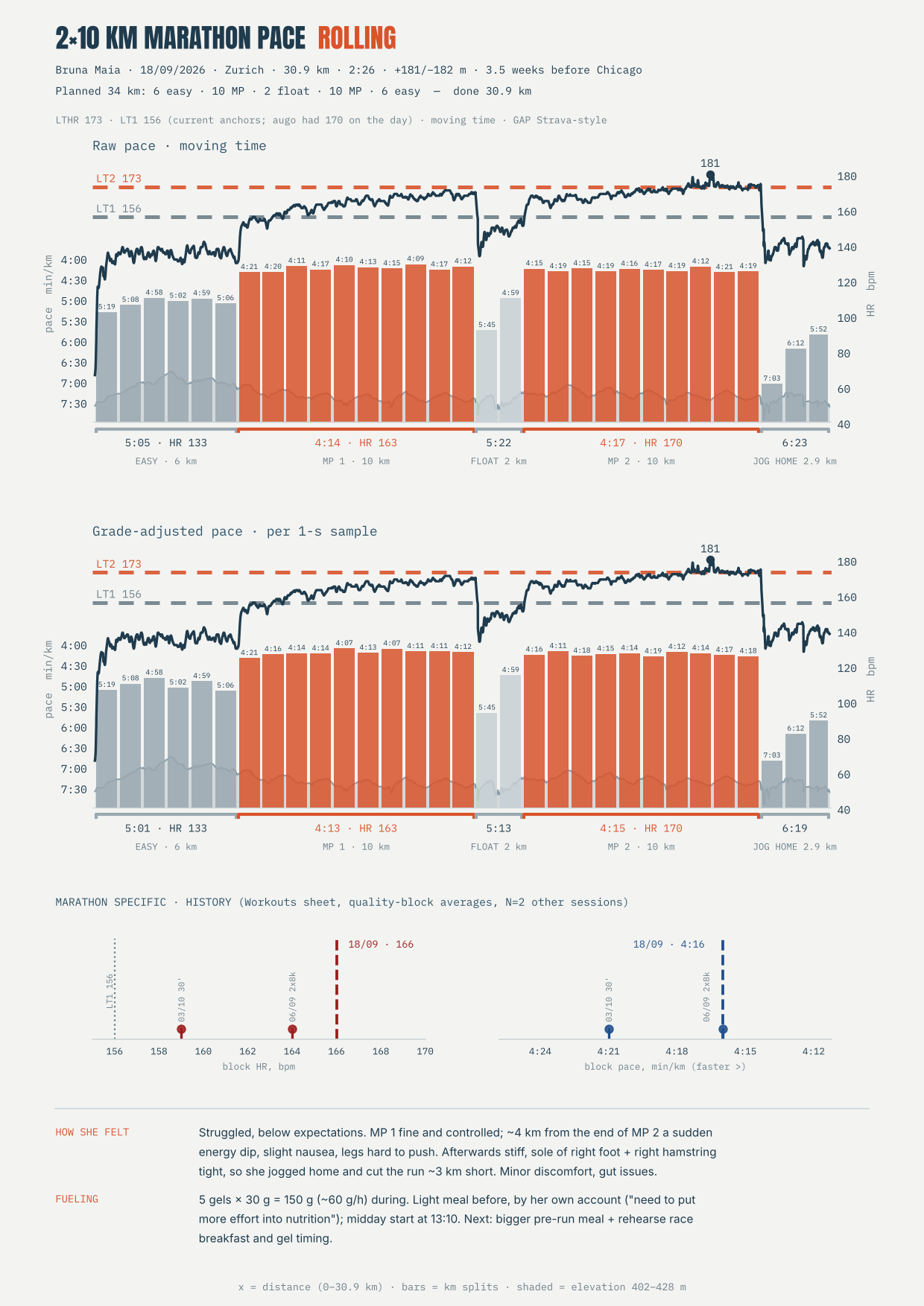
Then, we also look at workout data, and instead of having to select sub-sections of the data or relying on a myriad of the most useless plots ever designed (you know what I’m talking about), or scroll endless tables with splits (how hard can it be to average the splits? Please, I’m listening), you can just get the graphs you need by linking augo with Claude, and instructing the AI to process every workout in the way you consider the most useful to you. For example, for a trail workout, I want climbs and descents to be automatically detected and various parameters to be shown to me, in a way that is simply not available in outdated software.
I think this is how things need to be done because, as coaches (and athletes) we all want to look at slightly different things, which is also why some of the outdated software currently used has a library with a million useless graphs. The solution is not to have even more useless graphs, but it is to go custom: you get what you need, because you don’t have to code it; you just have to explain it to an AI assistant, once.
Here is what I built for my athletes, so that I can see what I care about after a hard session (their feedback + external and internal load with respect to their thresholds, GAP, for example), and how the latest session compares with the previous history of the athlete (density plots of external and internal load for a given stimulus, e.g. marathon pace here):
You can even schedule a task on Claude that each day at 6am goes into augo, looks at workouts from the previous day, and provides you with a set of analysis or graphs that you have previously instructed to build, so that you can analyze what you think matters, together with any other messages or else that is logged in augo, in the chat, in voice messages, in comments, where the relevant information is, you will see it easily without getting lost in WhatsApp where your mom and your athletes fight for attention.
Coaching has changed for the better. Get up to speed.
Lab Testing and True Individualization
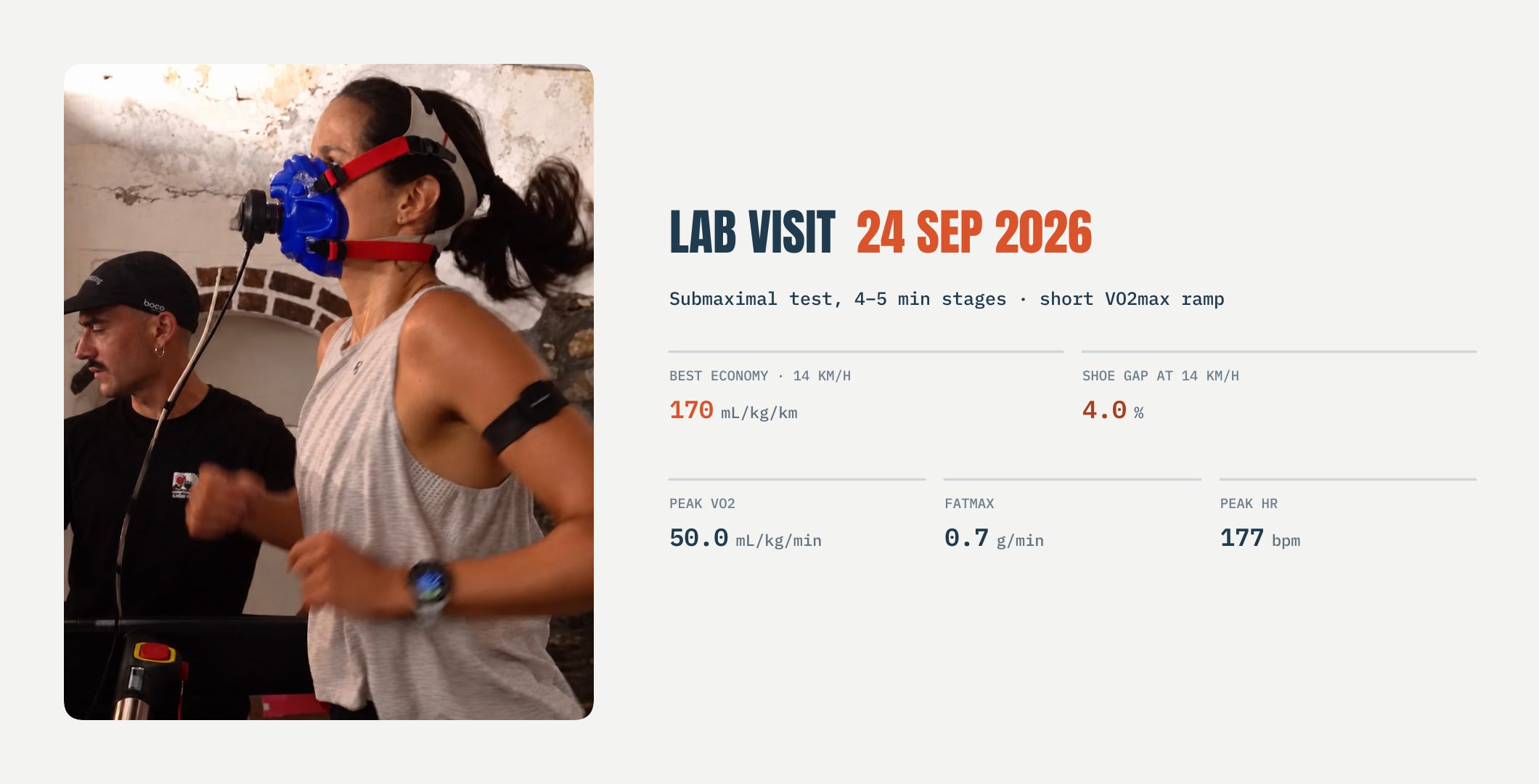
Bruna came to visit my lab about 2 weeks before the race. Normally I structure the protocols as follows:
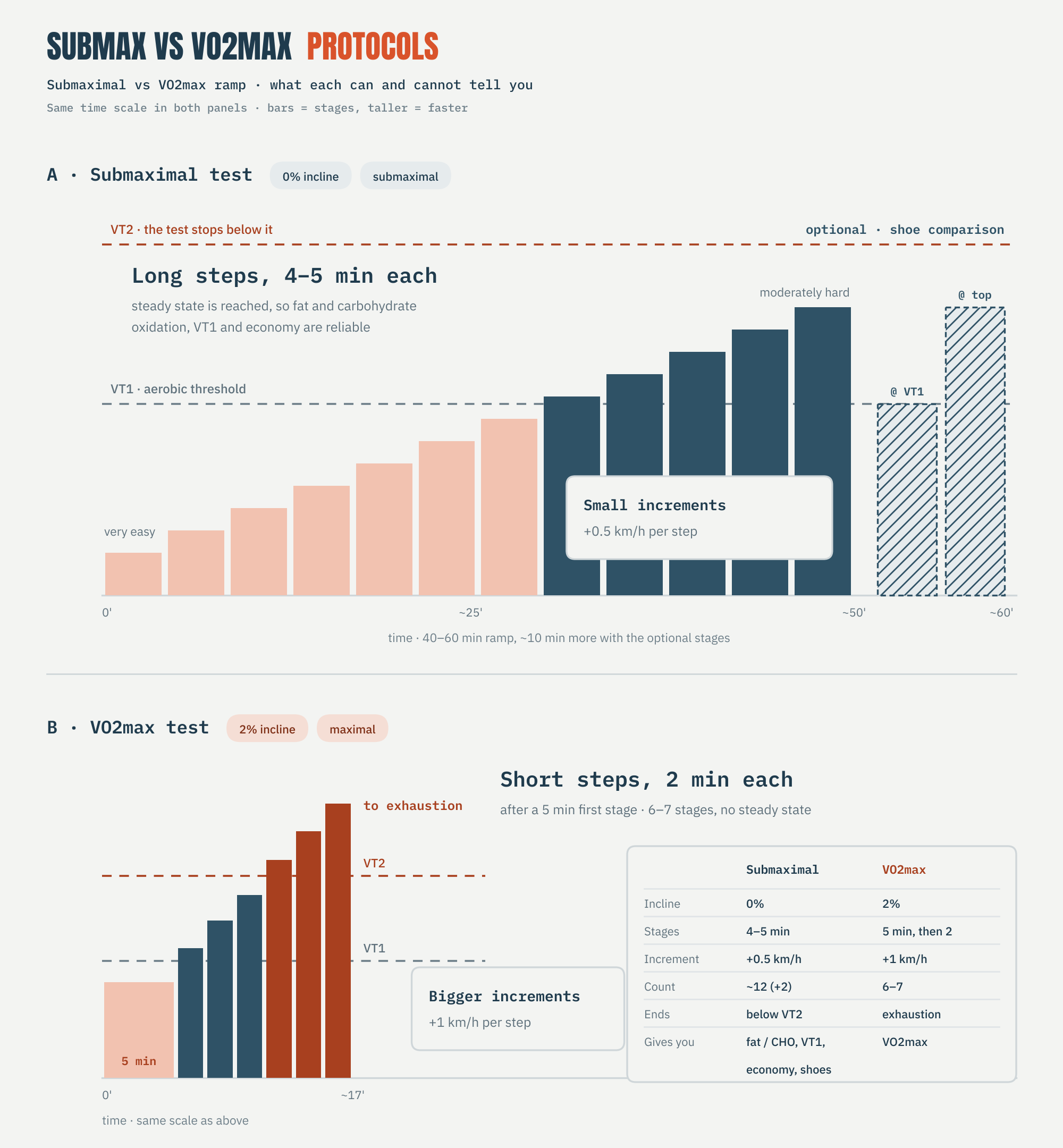
One submaximal test, which is the main thing I care about, where we go for 4-5 minutes each step, starting from an easy jog, up to about marathon pace. With this test, we can look at substrate oxidation (FAT vs CHO at different intensities), changes in ventilation around the first threshold, running economy, and differences in running economy using high-performance shoes. Note that the typical VO2max test with short stages, which you often buy with the idea of also looking at those things, cannot be used for any of that, because the stages are so short that you are never in steady state and as such, the derived variables will be inaccurate.
One maximal test, in which we do a 10-15 minute ramp to get to VO2max. In this second test, I like to start with a long stage again (5 minutes at low intensity), so that we can re-assess steady-state oxidation rates after 1 hour of running (duration of the submax test that is done beforehand). For a few athletes, typically on a high-carb diet but with good metabolism and durability (e.g. a good marathoner or ultrarunner), we tend to see a marked shift to increased fat oxidation with this assessment, despite refueling with 20-40g CHO between tests (as it was the case also for Bruna, see below).
Visually:
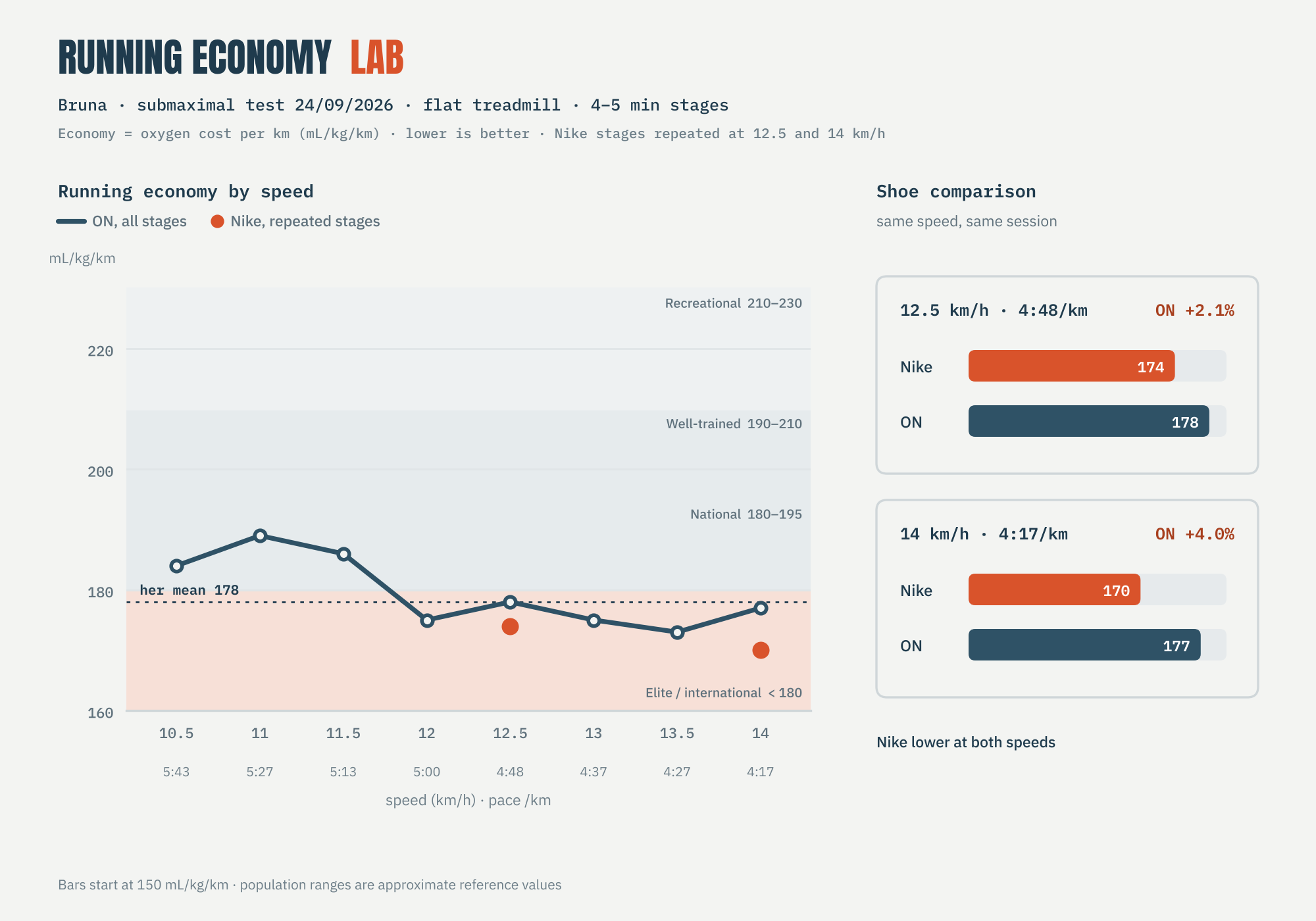
Eventually, Bruna’s profile was quite interesting: she’s one of the most economical people I’ve ever measured in the lab.
As I discussed in a podcast with her recently, VO2max and economy are tightly coupled. You can have a large VO2max just because you are very inefficient (as in my own example which I brought up in the podcast), but you can also have a more modest VO2max because you are incredibly efficient (as in Bruna’s lab data). The interplay of these variables (and some more) is reflected in the speed we run at VO2max, which indeed is nearly the same for both of us, given the same protocol. A VO2max of 65 vs 50 ml/min/kg, but with a cost of running of 210 vs 170 ml/km/kg, makes for the ~same velocity at VO2max and more or less the same marathon time, in our cases. How cool is that?
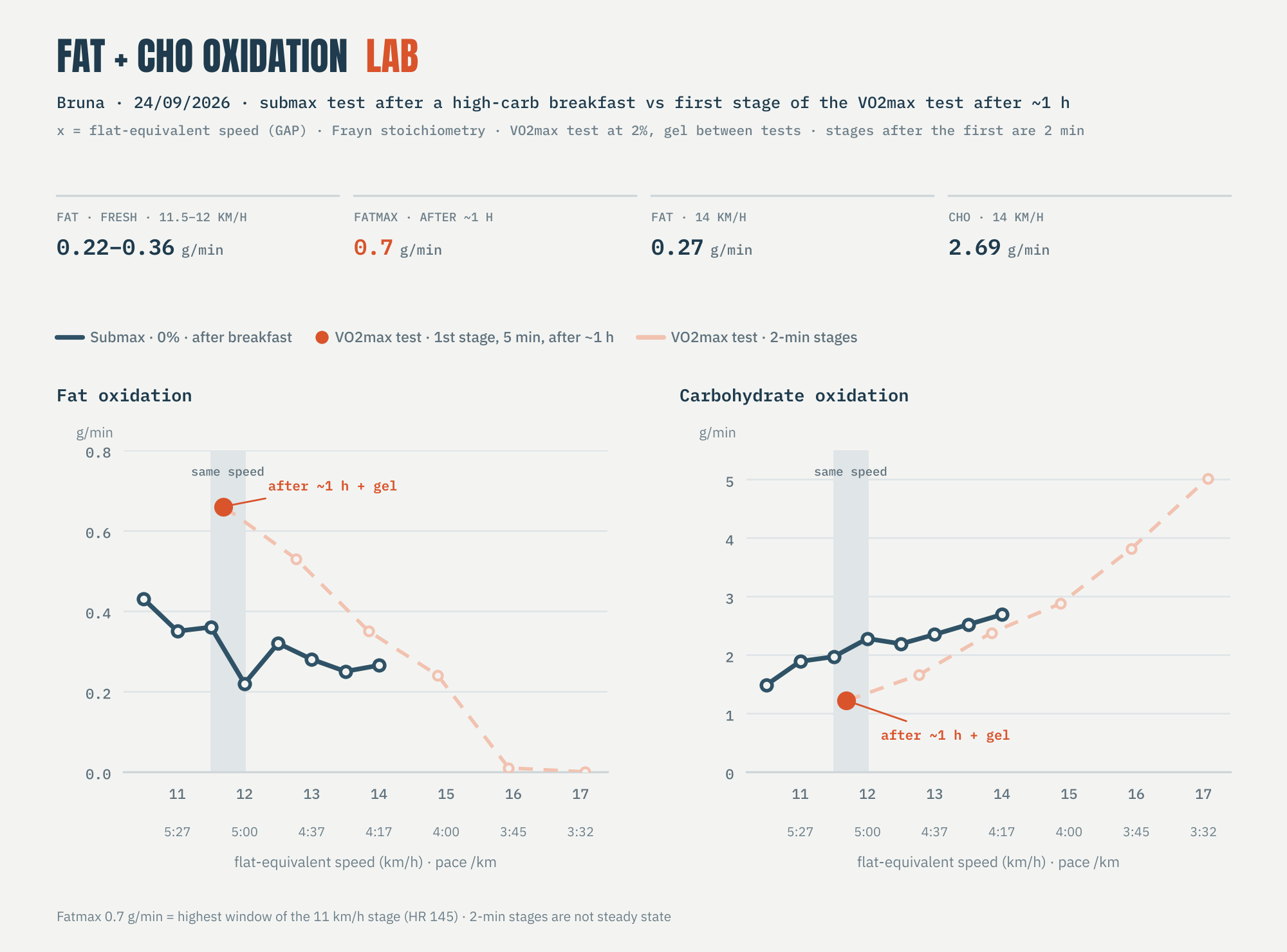
Something else I wanted to look at was her metabolic flexibility, or her substrate utilization at different intensities. Bruna has talked about her nutrition before (see here and here) and in particular how she’s suffered from relative energy deficiency (REDs), resulting in stress fractures. She’s since then been working with a nutritionist, and our focus over the past years has always been to make sure she’s fueled enough for the training she’s doing. From Bruna’s training, we can tell she’s got great durability. Despite overall training volumes that are on the low side, she can run 3-4 hours at a relatively high intensity with no issues. I think this type of profile tends to be reflected in an athlete’s metabolic flexibility, among other factors.
During our tests, we could see how her metabolism shifted quite dramatically towards higher fat oxidation rates after an hour of running. In particular, I think the predominantly high-carb diet + high-carb breakfast of that morning impaired fat oxidation at the start of the test, but given enough time, things switched. That’s metabolic flexibility that not many people have. This is a situation that will likely be reflected in the marathon (which is also why I like to test this way, I do not think it is meaningful to test fasted if we never run fasted, let alone racing fasted), where she’ll get to the race after a period (e.g. 48 hours) of higher carbohydrate intake, but will drift towards higher fat oxidation rates as the race progresses, which is what you want to delay fatigue.
Actionability for Training and Race Fueling
We test so that we can learn something about the individual and plan better for the future.
As I discussed elsewhere, for most things, we don’t need testing. We certainly do not need VO2max testing, for example. The paces we hit over months of workouts with different structures will tell us what we need to know about the top end, our threshold, and what our limiters are, when it comes to anything “above easy” (e.g. above VT1, LT1, etc.). For other things, though, e.g. our economy, and our substrate oxidation above all, testing can be useful, as there is no other way to infer these variables accurately.
In particular, given Bruna’s incredible running economy, as well as her history of bone stress fractures, we have one more reason to double down on cross-training (e.g. cycling), as one of the main reasons to be running more would be to (presumably) improve running economy, something we don’t really need here. We also have more reasons to do hard training on the bike, maybe as a second top-end stimulus during the week. Combining our knowledge of her workouts, history and lab data, we can plan accordingly. A runner with poor economy or with a larger aerobic engine - so to speak - would likely benefit less from large volumes of cross-training.
In terms of race fueling, we used the other software I built and described here, which estimates carbohydrate intake requirements based on the race duration (and profile, but that’s easy for a flat marathon), and on the athlete’s individual metabolic profile. Some athletes burn 1 gram of CHO / minute and some burn 4, at the same intensity, hence we want to fuel accordingly.
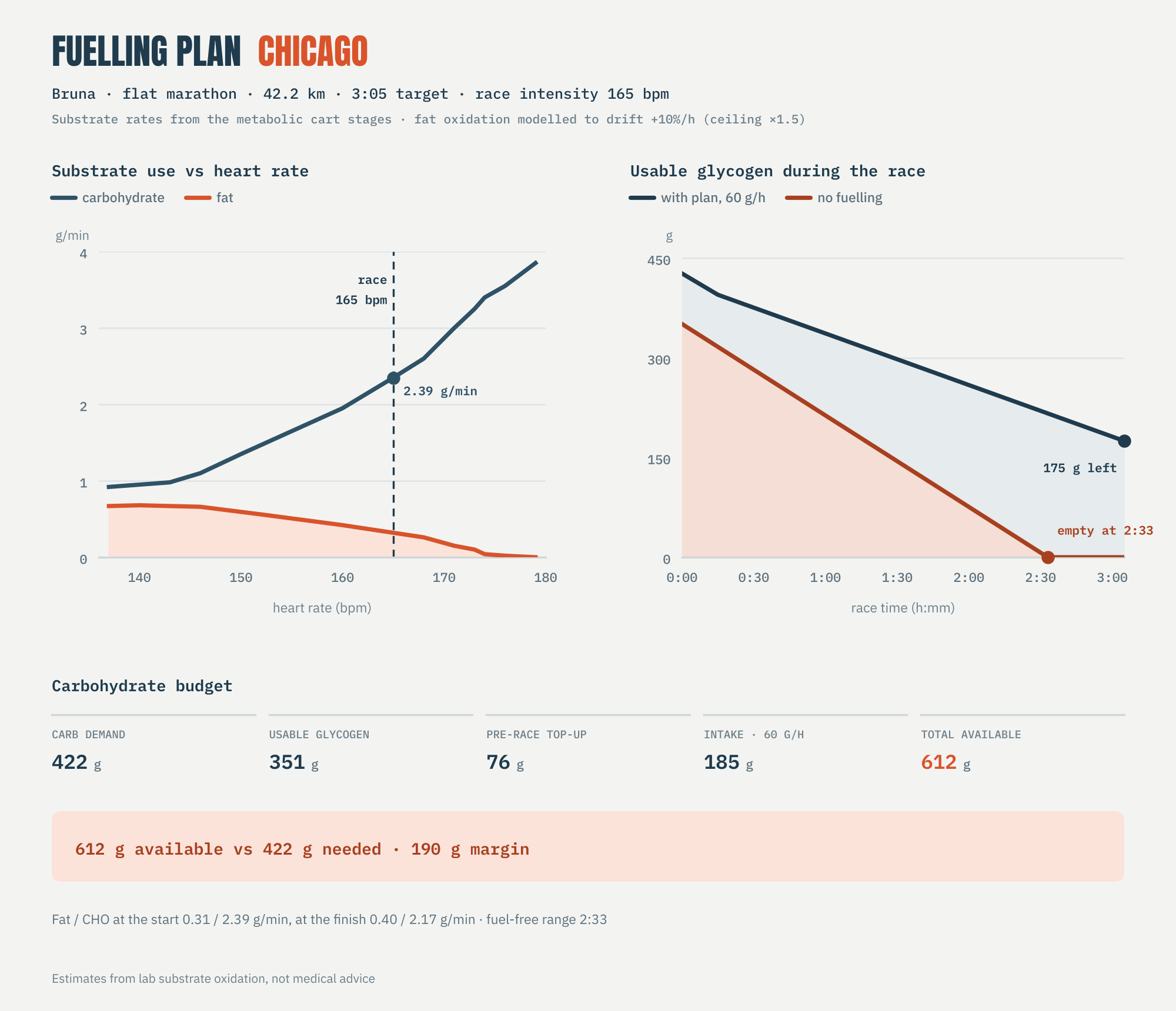
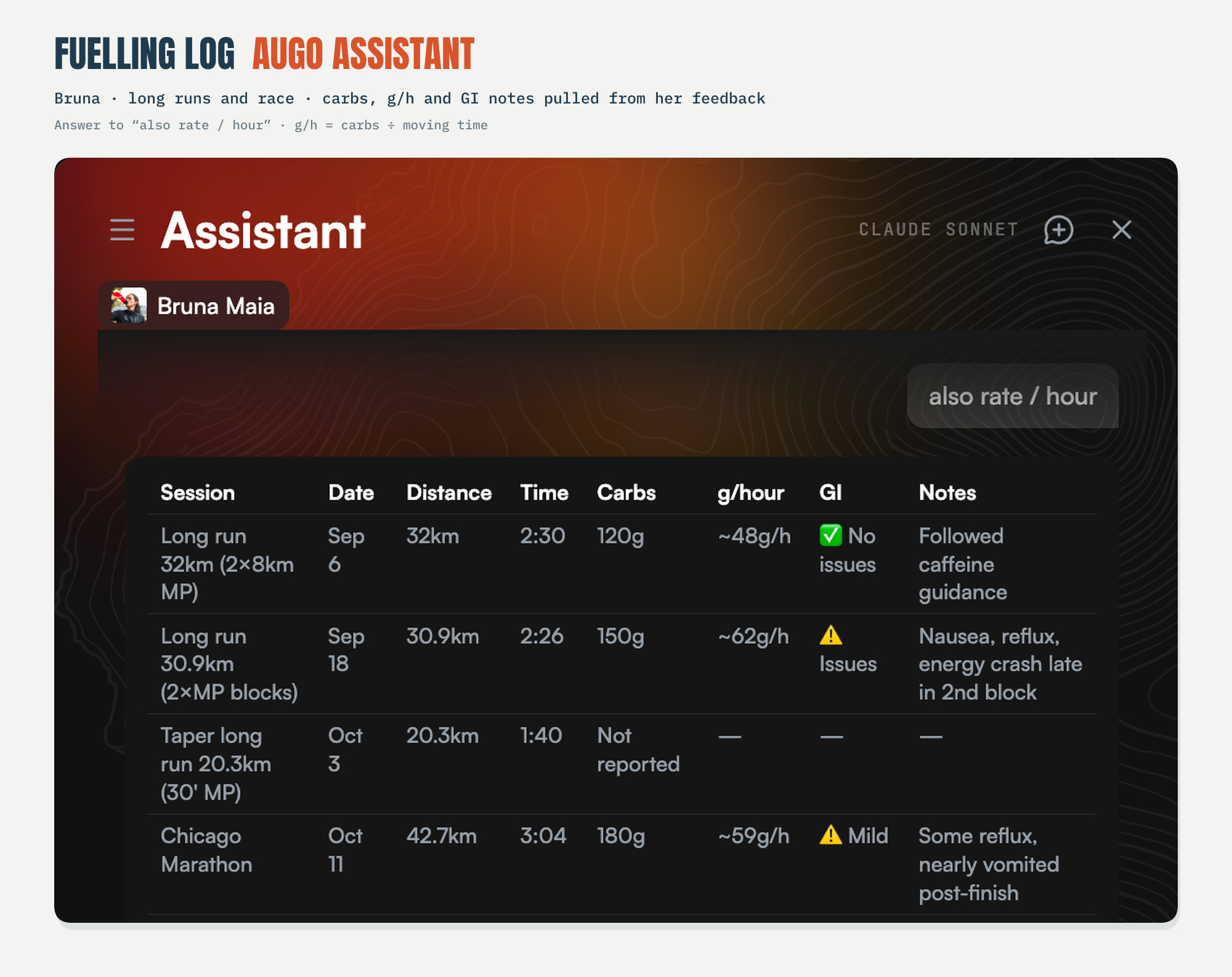
These of course are things to try and test in training, which we did for a few of her key workouts:
How We Trained
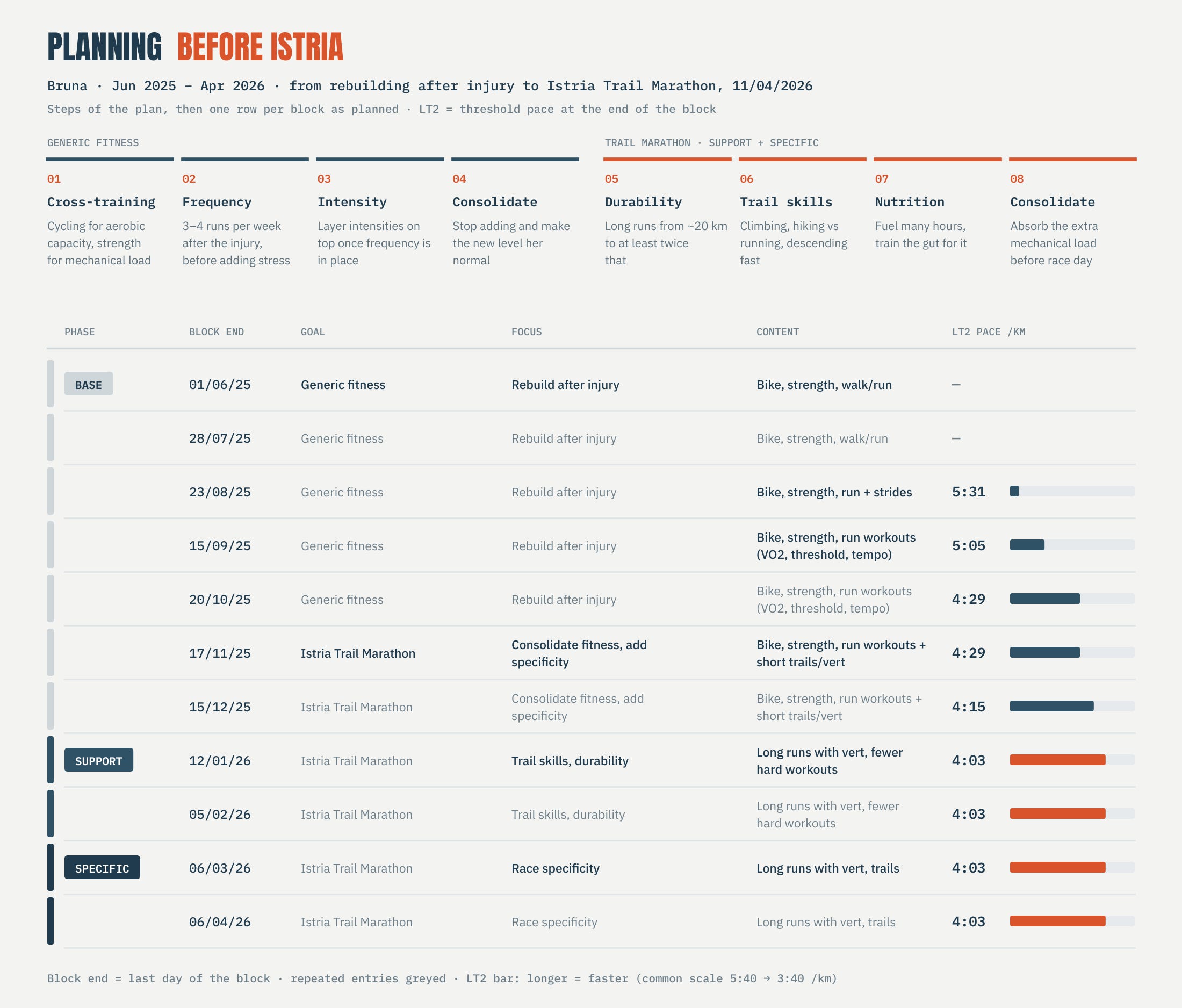
Before Istria, we were starting from zero (walk/run protocols). We first rebuilt general fitness: cross-training (bike and strength) and 3–4 runs a week, then intensity, then a consolidation phase to make that level her new normal.
Only then we started focusing on more specific work for Istria, running more vert, stretching long runs from ~20 km to twice that, building trail skills and practicing nutrition, before consolidating again ahead of race day. Estimated threshold pace (which I derive from workout data as a marker of fitness) went from 5:31 to 4:03 /km over those ten months.
After Istria, Bruna took a few weeks off, and we were back at it in July, which would give us 2 full months of summer training to prepare for Chicago (August and September, with the marathon in early October).
Given the limited time, I opted for maintaining a tried-and-tested structure, with limited running and a good amount of cross-training, but this time stressing our weaknesses more heavily (top end and mostly threshold, with rather demanding sessions), so that we could push our “fitness” further, and then rely on our strengths (economy and durability), with a rather short specific block, in which we would aim at practicing marathon pace feel and fueling with only two long runs with long marathon pace blocks (e.g. 34km with 2 x 10km at marathon pace). This is once again individualization and working with an athlete’s strengths and limiters. If your durability is an issue, your specific block had better be your main focus.
Here is an overview of Bruna’s training:
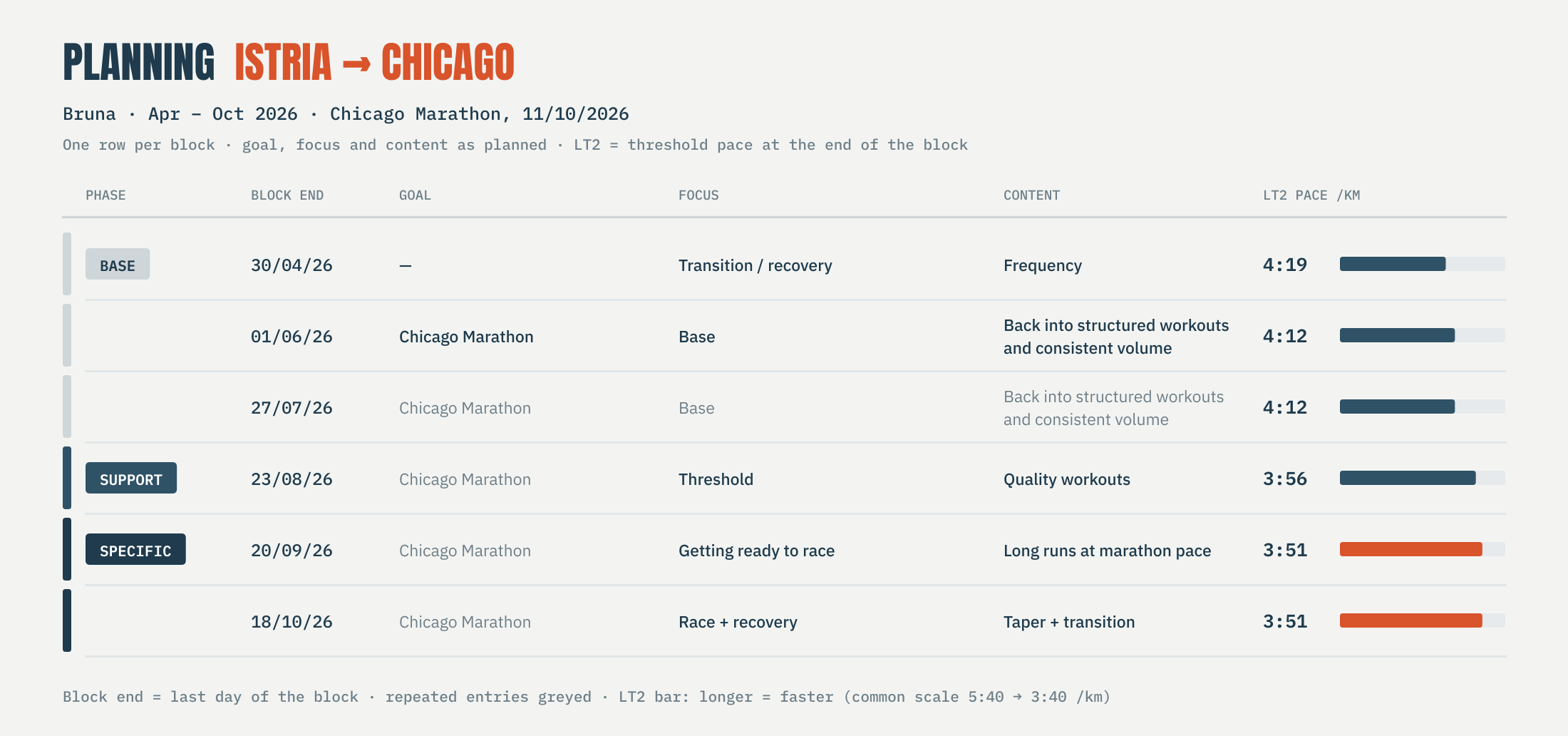
The threshold block worked pretty well, as we could see we stepped up our ability to sustain high intensities for a long time, eventually giving us the opportunity to push marathon pace further as well. Below are the key workouts of our 2-month build:
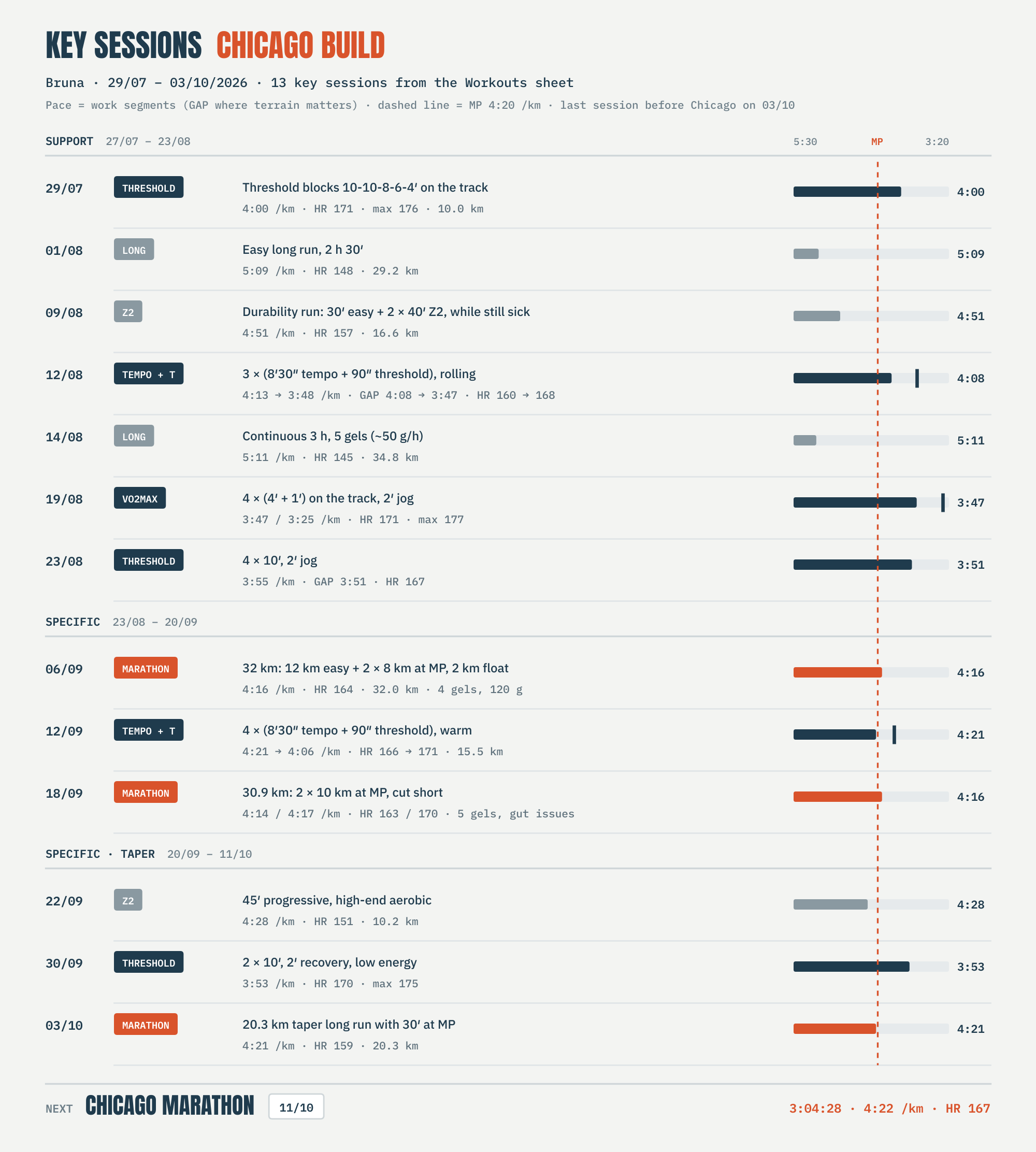
During the summer, we also kept plenty of trail running in the mix. I think this is a great way to add volume safely, once we have developed some basic capacity and skills (as we certainly did here by preparing for trail races in spring). The differences in terrain, elevations, impact on the ground, etc. make it so that we do not stress the tissues, bones, etc. so repetitively as we do when running flat roads. Our key sessions were done on flat roads or on the track, but mixing things up between roads, hills and trails has allowed us to run some bigger weeks without accumulating niggles or other issues.
Two weeks out from Chicago, Bruna’s biggest week was done mostly on hills and trails, when she came to visit in Brisighella (85 km for that week, while we averaged only about 50-60 km/week across summer).
You can become a better road runner by cycling, and you can certainly do so by trail-running, the most specific cross-training there is :)
The Race
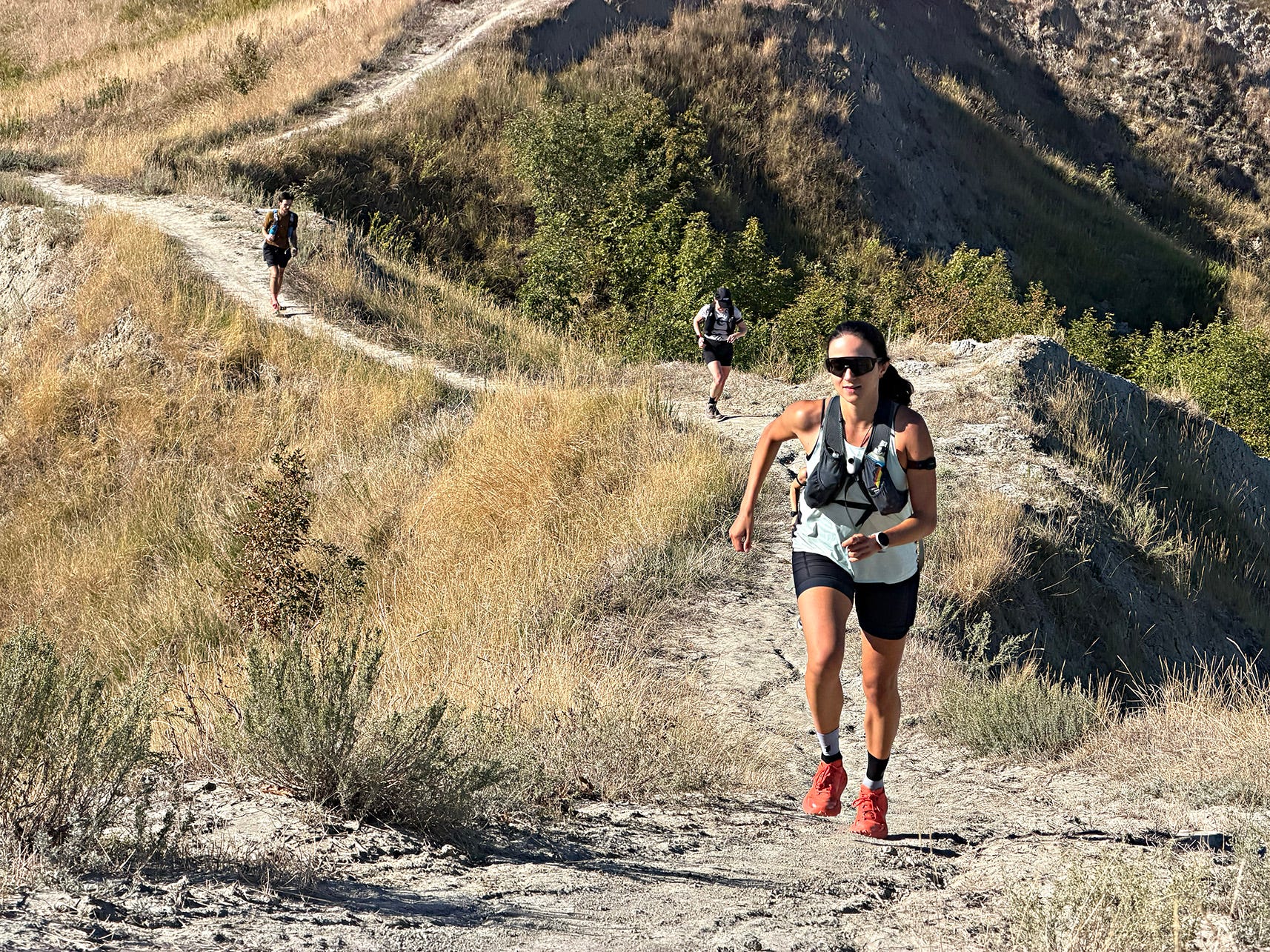
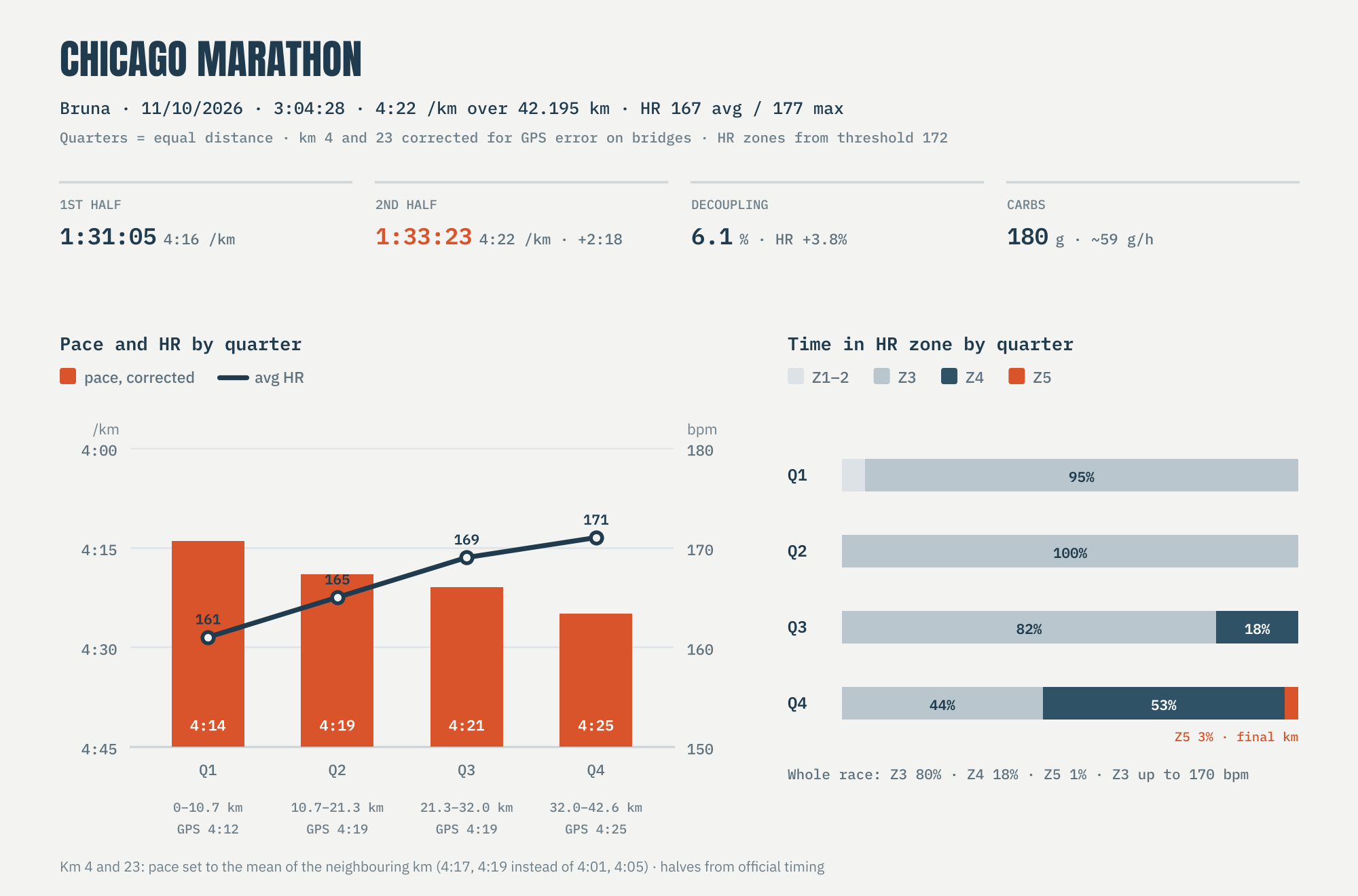
See Bruna’s post here for her own words about the race. On my end, I will say that it’s been a good year and a half, and this race was the cherry on the cake.
Bruna has run many marathons in the past ten years, and recently put a lot of effort into addressing what didn’t work in the past, with a holistic approach covering nutrition, cross-training, and listening more to her own perception and feel, often leading to holding back instead of pushing through, which eventually allowed us to stay healthy and make a big leap in performance with a ten-minute personal best.
No secret workouts, lots of common sense and good communication.
I am fortunate not only to coach Bruna but also to work with her and her team at augo, where we try to build tools that provide higher-quality coaching, with less time spent on gathering context, preparing data, and doing admin tasks, and more time spent assessing athlete feedback, interpreting data, thinking, planning, and communicating effectively so that we can help you reach your goals. This is of course an essential component of how we work together.
We’ll see what the future holds, but for now and once again, congratulations Bruna, and thank you for your trust.
Personal Coaching for Runners
Please apply here should you be interested in working with me.
You can also learn more about my coaching, here.
Thank you!

The Book
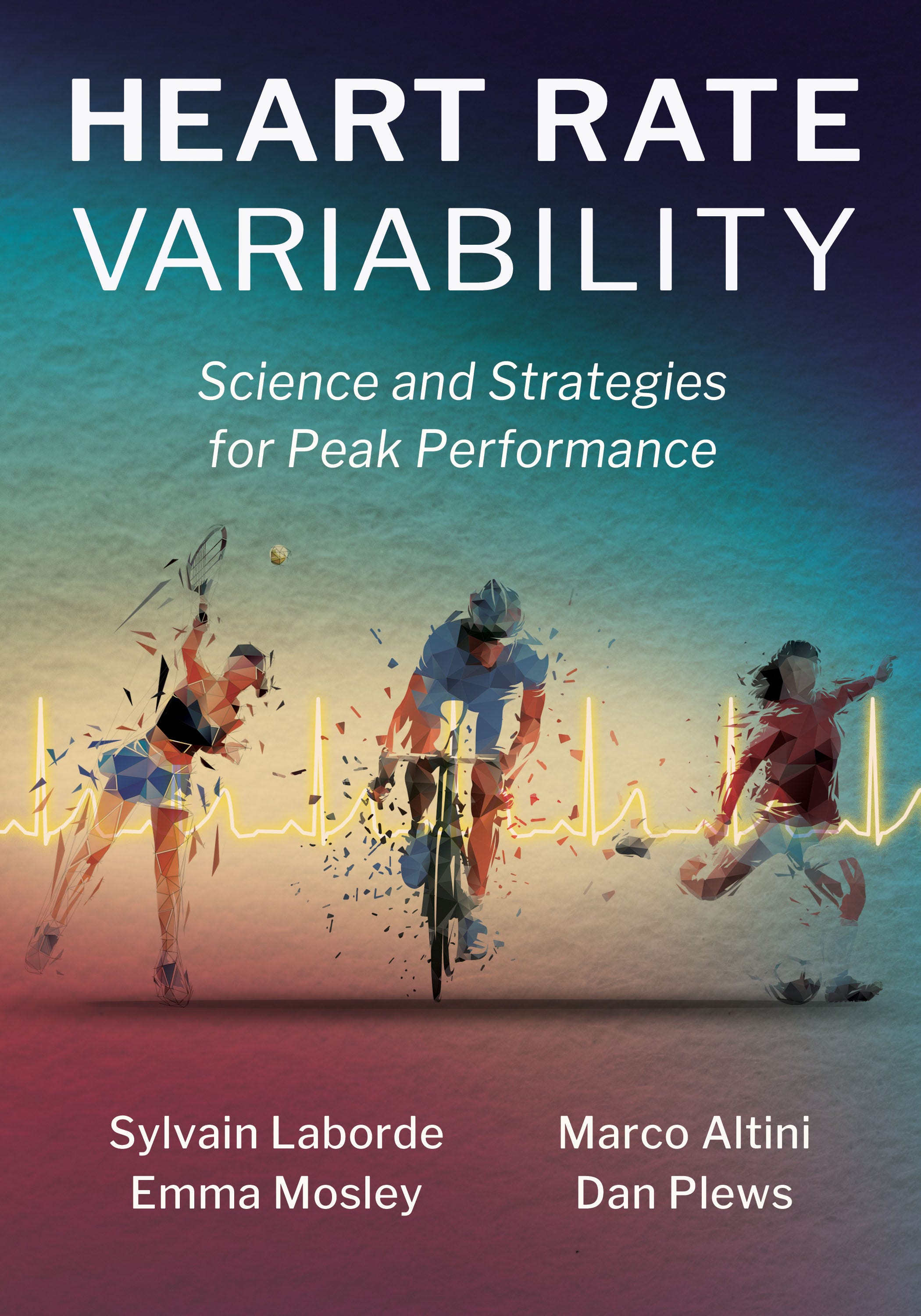
Our book is out and available for purchase from Human Kinetics’ website, here (or on Amazon).
How to Show Your Support
No paywalls here. All my content is and will remain free.
As a HRV4Training user, the best way to help is to sign up for HRV4Training Pro.
Thank you for supporting my work.

Marco holds a PhD cum laude in applied machine learning, a M.Sc. cum laude in computer science engineering, and a M.Sc. cum laude in human movement sciences and high-performance coaching. He is a certified Ultrarunning Coach.
Marco has published more than 50 papers and patents at the intersection between physiology, health, technology, and human performance.
He is co-founder of HRV4Training, Endurance Coach at Destination Unknown, advisor at Oura, guest lecturer at VU Amsterdam, and editor for IEEE Pervasive Computing Magazine. He loves running.
Social:
Personal Substack
Strava
Instagram
How do your athletes feel after dealing with AI slop during their day jobs with the necessity to deal with slop in your app? (I don't mean it disrespectfully, I can easily imagine it increases the efficiency of training, but at least I'm sure for many people the allergy to slop is just there at this point more efficient or not).